Most bike transport damage happens to mirrors, levers and fairings — all avoidable. Here is the packing and securing standard to insist on.
Key Takeaways
- Bikes need dedicated upright restraint systems, not car-style flat straps or tie-downs.
- Mirrors, levers and fairings must be wrapped individually before the bike enters any carrier.
- Fuel should be drained to a minimal level and the battery disconnected before dispatch.
- Wheel chocks plus fork or handlebar straps keep a motorcycle stable over long distances.
- A photographed condition report at pickup and delivery protects both owner and transporter.
Why bikes need different handling from cars
A car sits flat on four wheels and stays put under its own weight once the wheel straps are tightened. A motorcycle or scooter has a narrow contact patch, a high centre of gravity, and no inherent lateral stability. Every bump, lane change and braking event on the highway wants to tip it over. The securing method that works for a car — straps over the tyres and a level deck — simply does not apply to a two-wheeler without additional vertical restraint.
Bikes also have far more exposed fragile parts per square metre of bodywork than a car. Mirrors, lever ends, indicator stalks, fairing edges, exhaust tips and handlebar-end weights are all proud of the main body and break on contact. A car can absorb a minor nudge on a bumper with no visible mark; the same nudge against a fairing panel cracks the plastic. This is why bike transport requires a fundamentally different approach to packing and restraint.
Understanding these differences is important whether you are shipping a daily commuter scooter or a performance superbike. The physics of keeping a two-wheeler upright and undamaged over a thousand-kilometre highway journey are the same regardless of value — though the consequences of getting it wrong are obviously more expensive on a high-end machine.
Protective wrapping of mirrors, levers and fairings
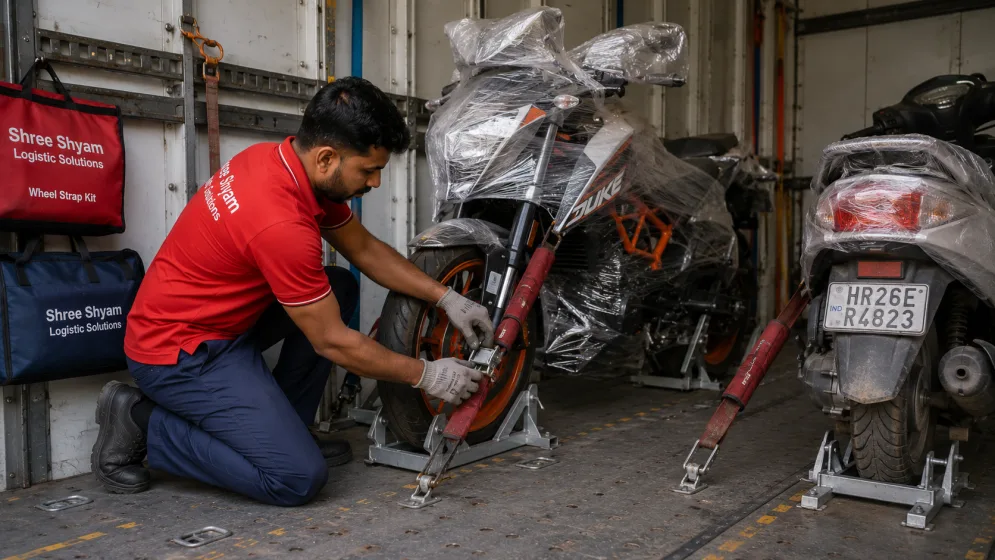
Before any motorcycle or scooter goes near a loading ramp, every protruding component needs individual attention. Mirrors should be folded inward where possible, then wrapped in foam or bubble sheet and secured with stretch film so the wrap cannot slide off during transit. Brake and clutch levers get the same treatment — a single layer of corrugated card bent around the lever and taped in place is often enough to prevent a snap from sideways pressure.
Fairing panels on sports bikes and faired scooters are particularly vulnerable at the edges. A layer of foam sheet over the lower cowl, side panels and tail section stops surface scratches from vibration contact with adjacent bikes or carrier walls. Indicator stalks, bar-end weights, exhaust tips and aftermarket crash bobbins all deserve a wrap layer. The goal is that nothing brittle or protruding is exposed to contact with any other surface.
This wrapping step takes a trained crew roughly ten to fifteen minutes per bike. It is not optional padding — it is the single most effective prevention measure against the cosmetic damage that accounts for the majority of bike-transport claims. Any operator who skips this step or rushes it is telling you something about their handling standards.
Need a quote while you read?
Share your route and vehicle — we reply with an all-inclusive price.
Wheel chocks and fork straps for upright stability
Once wrapped, the motorcycle needs to be held rigidly upright inside the carrier. The industry-standard method uses a front-wheel chock — a cradle that grips the front tyre from both sides so the wheel cannot turn or roll — combined with ratchet straps attached to the fork tubes or the lower triple clamp. Some operators use handlebar straps instead, pulling each side of the bar downward and outward at an angle so the front end is locked in compression.
At the rear, straps hook to solid frame points or the swingarm spools, never to grab rails or pillion pegs alone. The idea is to keep the suspension slightly compressed so the bike sits firmly in its travel and cannot bounce. A correctly strapped motorcycle should not move more than a centimetre in any direction when you push it. Soft ratchet straps with fabric loops are preferred over metal hooks directly on painted surfaces.
- Front-wheel chock locks the tyre and prevents rolling or steering movement.
- Fork or handlebar straps compress the front suspension slightly to remove bounce.
- Rear straps attach to solid frame points, swingarm or axle-area mounts.
- Soft-loop straps avoid metal-to-paint contact on the frame.
- The bike should not shift more than a centimetre in any direction once secured.
Why strapping over the seat or suspension alone fails
A common shortcut is to throw a single strap over the seat and tighten it to the carrier floor. This feels secure at first glance, but it achieves almost nothing useful. The seat foam compresses over time, which loosens the strap. The downward force is applied to the subframe or seat rail rather than through the suspension geometry, so the bike can still pivot at the steering head. Worse, strap pressure on a leather or vinyl seat leaves permanent indentation marks.
Strapping only at the rear suspension linkage or the shock absorber mount is equally problematic. It compresses the rear without locking the front, so the bike can pitch forward or rotate around the headstock. The correct approach always involves both front and rear restraint working together — the front locked by a chock and fork strap, the rear held by frame-mounted tie-downs. Any single-point method is a half-measure that works until the first heavy braking event on the highway.
Fuel draining and battery disconnection before dispatch
Fuel is a fire and spillage hazard inside an enclosed carrier, especially in summer when temperatures inside a metal trailer can climb well above ambient. The standard practice is to drain the tank to a level just sufficient to start and ride the bike off the carrier at delivery — typically below a quarter tank. Some operators drain completely and push the bike on and off, which is acceptable for short ramp distances. Petrol drained from the tank must be disposed of safely, not stored in open containers on the carrier.
Battery disconnection prevents a flat battery from an alarm, clock or slow parasitic drain over a multi-day journey. It also removes the ignition circuit from the equation in the unlikely event of a fuel vapour situation. Disconnect the negative terminal, tape it away from the post, and secure the terminal so it cannot vibrate back into contact. For scooters with under-seat batteries in awkward positions, at minimum switch off the kill switch and remove the key.
These are safety requirements, not preferences. A responsible transporter will refuse to load a bike with a full tank or an active electrical system regardless of the owner's wishes, because one bike puts every other vehicle on that carrier at risk.
Crating versus bike carriers versus shared transport
There are three main ways a motorcycle travels long distance. Full wooden crating encloses the bike in a custom frame with foam-lined contact points — it offers maximum protection but costs more and takes longer to build and unpack. It makes sense for international shipping, rare or vintage bikes, or situations where the bike will be handled by multiple parties in warehouses or ports where you cannot control the environment.
Dedicated bike carriers — either standalone or a section of a larger enclosed vehicle fitted with multiple wheel chocks and strap rails — are the standard for domestic transport. The bike rides upright, accessible for inspection at any point, and loading and unloading is straightforward. This is the most common method for moving motorcycles between cities across India, and it balances cost, safety and convenience well.
The third option is bikes travelling alongside cars inside a mixed carrier. This works if the carrier is properly fitted with a bike-specific bay that has its own chock and strap points, and if there is guaranteed clearance between the bike and any car. It is the cheapest option on shared routes like Gurgaon to Bangalore, but the trade-off is that your bike shares space and the carrier fills on a schedule dictated by car bookings, not yours.
- Wooden crating: maximum protection, higher cost, best for rare or export bikes.
- Dedicated bike carrier: upright, accessible, standard for domestic city-to-city moves.
- Shared carrier with cars: cheapest per-bike, but schedule depends on car bookings.
- Choice depends on bike value, distance, timeline flexibility and handling risk.
Superbikes and heavily modified motorcycles
High-performance and modified bikes introduce additional considerations. A superbike with a full fairing set, carbon fibre bodywork, aftermarket exhaust, lowered suspension or extended swingarm needs the transporter to know the exact dimensions and ground clearance in advance. Low belly pans can catch on standard ramps. Wide aftermarket rear tyres may not fit a standard-width wheel chock. Clip-on handlebars offer less purchase for handlebar straps than a standard bar.
Communicate all modifications clearly when requesting a quote. Send photographs showing ride height, any non-standard width at the bars or rear axle, and the location of solid strap points on the frame. A responsible operator will check whether their equipment suits your bike and may need to adjust chock width, use axle straps, or assign a specific carrier bay. The worst outcome is a crew arriving unprepared and improvising a method that damages bodywork or stresses components not designed to take load.
Documentation you need before and during transport
Keep photocopies or scans of your registration certificate, insurance policy, pollution certificate and any NOC if the bike is registered in a different state from where it is being transported. The transporter needs a copy of the RC at minimum for their own consignment paperwork. If the bike is being sent by someone other than the registered owner — a mechanic, a friend, a family member — a simple authorisation letter with the owner's signature and ID copy avoids complications at checkpoints.
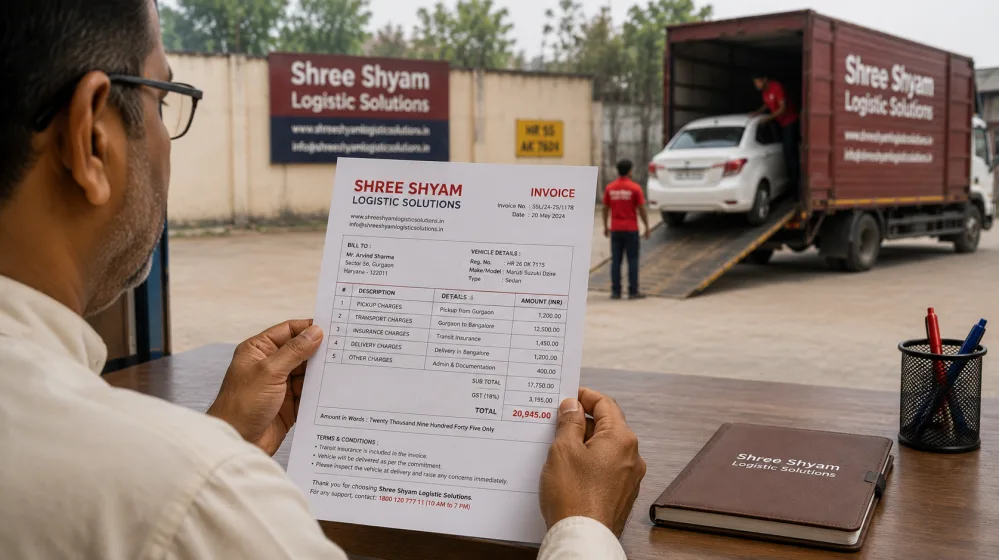
You should also receive a proper consignment note or transport receipt from the operator. This document should list the vehicle make, model, registration number, pickup and delivery addresses, and the agreed delivery window. It is your proof of contract and your reference if you need to raise a concern later. Retain it until after delivery and final inspection are complete.
- Registration certificate copy (mandatory for consignment note).
- Valid insurance policy document for the bike.
- Pollution Under Control certificate.
- NOC if transporting across state registration boundaries.
- Authorisation letter if someone other than the owner is handing over.
- Consignment receipt from the transporter with vehicle and route details.
What to check when receiving your bike at delivery
At the delivery end, do not sign the acceptance sheet until you have completed a thorough visual inspection. Walk around the bike and compare it against the condition photographs taken at pickup. Check mirrors, levers, bar ends, indicators, fairing edges, tank surface, seat condition, exhaust tip and both wheel rims. Look underneath for any scrape marks on the belly pan or exhaust headers that were not present before.
Test that the steering turns lock-to-lock without resistance, that both brakes feel normal at the lever, and that the front fork has no new pitting on the stanchions from strap damage. Start the engine briefly and listen for anything unusual. Reconnect the battery terminal that was disconnected, check the fuel level matches what you agreed, and confirm the odometer reading against the pickup report. Only sign once you are satisfied — your signature on that sheet confirms you have accepted the bike in its delivered condition.
If you spot damage, photograph it immediately with the bike still on or beside the carrier, note it on the delivery paperwork, and ask the crew to acknowledge it in writing. This documentation is essential for any subsequent insurance or damage claim and should be done before the carrier leaves your location.
Frequently asked questions
Can a scooter be transported the same way as a motorcycle?
Yes. Scooters use the same wheel-chock and strap method as motorcycles. The main differences are that scooter panels scratch more easily and need extra wrapping, and access to the battery may be less convenient. The securing principles — upright stance, front and rear restraint, minimal fuel — are identical regardless of whether the two-wheeler is geared or automatic.
How much fuel should I leave in the tank before transport?
Leave just enough to ride the bike off the carrier at delivery — roughly one to two litres at most. A full tank adds unnecessary weight, increases fire risk inside an enclosed carrier during summer, and may leak from the breather hose if the bike tilts even slightly. Most transporters will refuse to load a bike with a visibly full tank.
Is it safe to transport a bike with aftermarket accessories fitted?
Generally yes, but inform the transporter in advance. Items like crash guards, top boxes, panniers, tall windscreens and auxiliary lights change the overall dimensions and may interfere with standard strap positions or chock clearances. Removable accessories like phone mounts, GPS units, tank bags and loose mirrors should be taken off and carried separately to avoid damage or theft.
What happens if my bike is damaged during transport?
The photographed condition report taken at pickup is your key document. If you spot damage at delivery, photograph it before signing acceptance and note it on the delivery sheet. A reputable transporter will acknowledge the issue on the spot. Transit insurance, if arranged, covers repair costs — but only if the damage is documented at both ends and reported immediately.
Talk to a vehicle transport expert
Every route and every vehicle is slightly different. If you would like this applied to your specific case — a particular car, a particular route, a particular deadline — call us on +91 99907 81652 or send us an enquiry. You will get a straight answer and a transparent quote.